A solution would be to use the 12V PIR sensor I posted above. This is a Honeywell IS215T.
http://www.reuk.co.uk/buy-12V-PIR-SENSOR.htmUnfortunately there are two problems with this PIR sensor:
1) it needs a 12V supply and your alarm uses 9V so can't easily steal power from the alarm. Means you need another 12V adaptor or more design work (possibly to change the alarm so it also runs off 12V).
2) The PIR output is "normally closed". Apparently many 12V PIR sensors have normally closed outputs which is a pain. The simplest solution is another relay between the PIR and the alarm something like this.
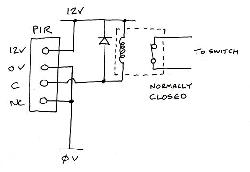
Note that it says "normally closed" contacts should be used. That might seem wrong but it's because the relay will be energised most of the time and only turn off when the PIR detects someone. So in fact the contacts will be open most of the time.
There are probably more elegant ways to do it but they might involve modifying the alarm or attaching wires to somewhere else in the alarm other than at the switch.






 Pages: 1


 PIR replacing switch problem (Read 11952 times)


